Showing posts with label being yourself. Show all posts

2 December 2019

Celebrating difference

God made us all, each wonderfully different...


(Church of England, Common Worship service of Holy Communion)


School Chaplain Reverend Jo Davis reflects on the importance of seeking to understand the differences and similarities in everyone we meet whilst, above all, treating them with kindness as a fellow human being...

Since I arrived at Bryanston 10 weeks ago, I have been told many times that there is no Bryanston type. That our aim is not to fit everyone into a mould, but to support them to become a fuller, brighter version of themselves.

I believe that everyone in the world has an equal right to exist and have their own beliefs and opinions. As a Chaplain, it is my job to support and pastorally care for everyone in the school, religious or not. If their faith differs from mine, it’s my responsibility to ensure that they are supported in their faith.


You rejoice in our differences, yet we make them a cause of enmity.


As an RS teacher, I have taught all six of the major faiths including atheism. I consider it a privilege to do so, but I also think it is hugely important. Just because I disagree with someone, it doesn’t mean that I do not need to understand their point of view. Learning about Islam to teach it to GCSE level has given me many opportunities to reflect on my own faith. If we don’t understand the opposing view to our own, how do we know that we don’t agree with it? We should seek to understand the differences and similarities in everyone we meet whilst, above all, treating them with kindness as a fellow human being.

This culminated on Wednesday last week in my attending a book signing with Richard Dawkins in Bath, accompanied by a group of A2 pupils. A man who, it could be said, has views diametrically opposed to mine, but I was still looking forward to it. 

When doing some research beforehand I was staggered to come across a video entitled ‘Love Letters to Richard Dawkins’ where he reads out some of the horrifically offensive emails he receives, many from people claiming to be Christian, but wishing him a horrible death and eternal suffering in hell. 

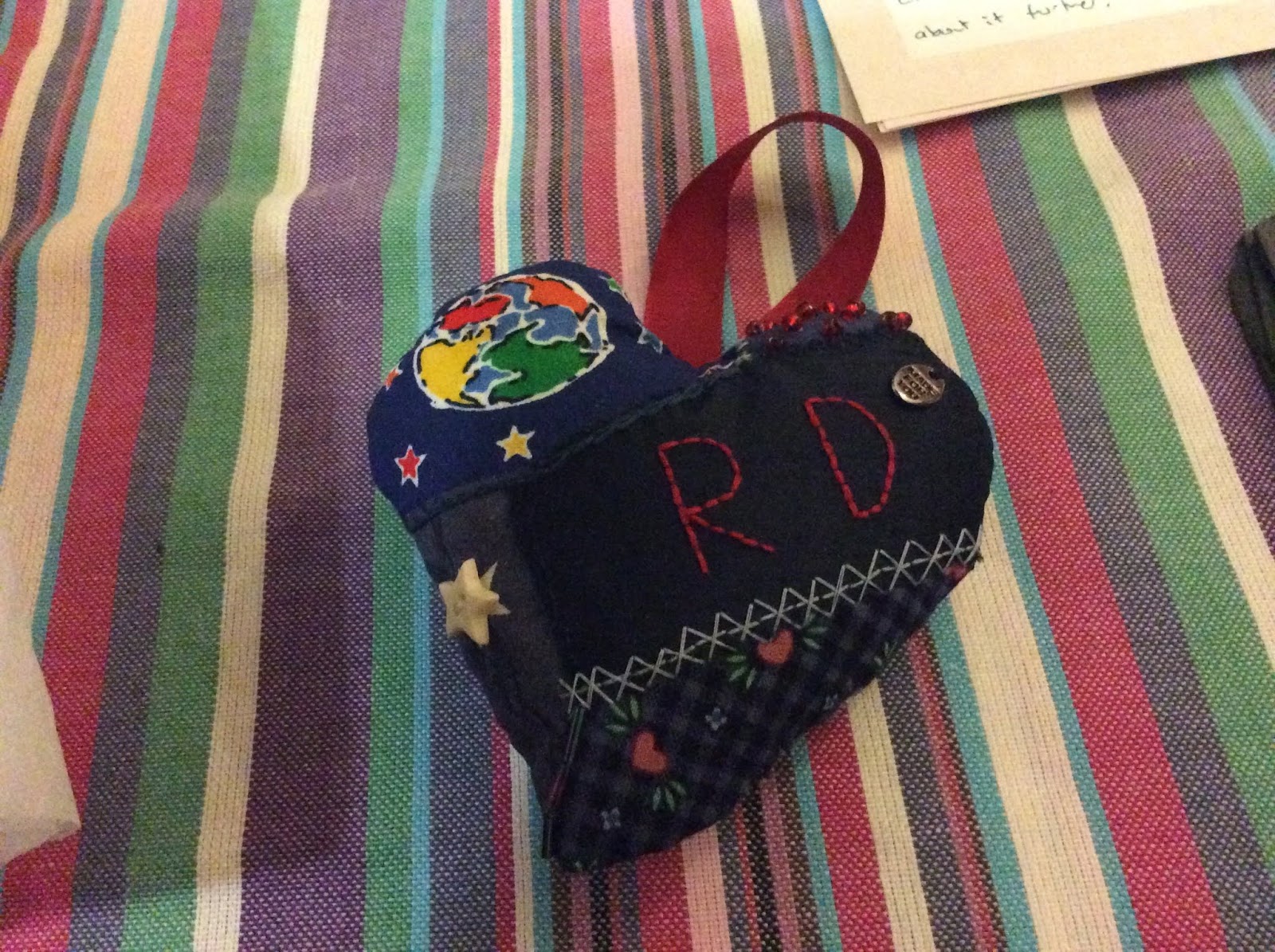
I could not believe it, and it spurred me on to attend the signing and be nice to the man. But I wanted to do more than that and felt called to show him a different side of Christianity, the faith that teaches me to love God, and love my neighbour as myself. Love is the most important command, and overrides everything else. I have recently discovered the Craftivist movement, which seeks to spend time and effort protesting positively, quietly and kindly through handmade items. I set about creating a gift for Richard that celebrated our commonality. Nothing inflammatory or that challenged his world view, apart from maybe what Christians were like. It was a challenge to find him after the Q&A session, but I managed it, and was able to shake his hand and pass over my letter and gift.


I was amazed to receive a personal email from him later in the evening, thanking me for the gift. 

This week I have challenged all the D pupils to investigate a view that is the opposite to one they hold, to do some research and look into their similarities and differences. Difference should be celebrated, not feared.

As a result, I’m really looking forward to Bryanston’s Craftivist Group, an extra-curricular activity (ECA) which I will be hosting from January. Craftivists aim to change the world through well-thought-out, quiet and kind acts of loving protest.

19 July 2019

Life is the adventure

A few weeks ago I spoke at my last Speech Day as a Head of Bryanston School. A leitmotif of my final chance to hold forth to a full Greek Theatre was of not outstaying one’s welcome and knowing when it is the right time to stay or to go. I used one of my favourite poems, which I quoted on my first Speech Day at Bryanston 14 years ago, as part of the text. 


Ithaka
As you set out for Ithaka
hope your road is a long one,
full of adventure, full of discovery.
Laistrygonians, Cyclops,
angry Poseidon—don’t be afraid of them:
you’ll never find things like that on your way
as long as you keep your thoughts raised high,
as long as a rare excitement
stirs your spirit and your body.
Laistrygonians, Cyclops,
wild Poseidon—you won’t encounter them
unless you bring them along inside your soul,
unless your soul sets them up in front of you.

Hope your road is a long one.
May there be many summer mornings when,
with what pleasure, what joy,
you enter harbors you’re seeing for the first time;
may you stop at Phoenician trading stations
to buy fine things,
mother of pearl and coral, amber and ebony,
sensual perfume of every kind—
as many sensual perfumes as you can;
and may you visit many Egyptian cities
to learn and go on learning from their scholars.

Keep Ithaka always in your mind.
Arriving there is what you’re destined for.
But don’t hurry the journey at all.
Better if it lasts for years,
so you’re old by the time you reach the island,
wealthy with all you’ve gained on the way,
not expecting Ithaka to make you rich.

Ithaka gave you the marvelous journey.
Without her you wouldn't have set out.
She has nothing left to give you now.

And if you find her poor, Ithaka won’t have fooled you.
Wise as you will have become, so full of experience,
you’ll have understood by then what these Ithakas mean.

C. P. Cavafy
(Translated by Edmund Keeley)

For me this is the most remarkable poem, and for many reasons. It talks of life as something one shouldhope will be an adventure, a road full of discovery. It talks about the monsters you will find onyour way: the Laestrygonians, Cyclopes, and even an angry Poseidon. It talks too of summer mornings and the many harbours you will find where you can buy fine things. Of visiting Egyptian cities to learn (and go on learning) from their scholars. It talks of perhaps,and if so, only finally, finding Ithaka, your homeland to which you will return, and of not being disappointed if she seems now poor after your life well-travelled. Because the point of life is the travel: the point of life is the adventure.

I don’t think I quite knew what I was taking on 14 years ago; I find that Cavafy means just as much or more to me now, as I push off from this harbour and move on to the next. I shall not pretend that I have not met my fair share of Laestrygonians and even the odd Cyclops in my time here. I like Cavafy’s point that we tend to bring these monsters with us; it’s how we respond to the travelling, the adventure, those monsters, and the joyful engagements that life is all about. 


But, oh how the wonderful moments far outshine these monsters. And these wonderful moments are mainly, but not completely, formed around our pupils. That’s why people join the teaching profession: being involved with growing minds and their nurture is the greatest privilege. 

Kairos esti. More Greek, this time ancient. It’s the right time. That sense that, although one’s job may never be fully completed and although there’s always more you can do, that you still love a place and its people, that the mission is as clear as ever, it is, nevertheless, time to move on. It is for me and it is too for our departing A2s. Most of them joined us five years ago and, boy, they’ve grown along the way. Zeynep, our wonderful Head Girl, dancing her socks off here, learning how to stretch right outside her comfort zone, and off to study History of Art and to continue to excel. Some of that is predictable, but I might have expected her to settle for merely being an international skier: not Zeynep. Then Cameron, our Head Boy, who joined us just two years ago in the sixth form, who is my first Head Boy who joined in A3. Cameron’s drive, energy and passion to get things done and done right is a lesson to us all. Together he and Zeynep have led a superb group of prefects and I could not be more proud of all of them. Or of Kate and Amadea off to top music schools in London. Or Sumei off to Durham perhaps, for Modern Languages, to be followed by a Masters in Music, I hope: with a voice like Sumei’s, surely she must! Or Freddie winning not one but two organ scholarships to two prestigious universities and a further one to St Paul’s Within the Walls, Rome and still loving a good suit and a proper cup of tea. Or Luca and his outstanding music and contributions to it all. Or Clara and her remarkable drama. (Will I ever get over her portrayal of me?) Or Callum and his ability to lead, drive, and succeed. Or Molly; wherever she chooses to go to university she’ll be brilliant, and then on, no doubt, to run a small country somewhere. Or Frankie off to Loughborough via Singapore.   Do they represent the hope of our prospectus? To produce well-rounded 18-year-olds ready to go out and contribute to the world. Yes, they do. Is that what we all hope for our children? Lord, I hope so. I want all the A2s to be able to move on and do something. To keep doing and be happy. To be involved and engaged. To know their real worth and what they can bring to the enterprise, whether that’s a ski season in Japan or linguistics at Oxford, I don’t mind. But I do think they should be equipped to deal with this world and to do so in a way which will bring them joy, as Cavafy promises us, on their own road to Ithaka.


As our departing A2s leave to travel along that road, I commend to them first these famous words of Tennessee Williams:

The world can be violent and mercurial and always has been. It will have its way with you. We are saved only by LOVE. Love of each other. Love that we pour into the art that we feel compelled to share. By being a parent, being a writer, being a painter, being a friend.

And finally in my own last words to all A2s: Go out and spread the Bryanston message. The world needs it. Be wonderful. Be an aardvark, a flamingo or a tiger. But, whatever you do, be yourself. And don’t be a sheep. BAAA!


We would like to thank Sarah Thomas for her outstanding leadership of Bryanston throughout her 14 years as Head. We wish Sarah and her family all the best as they set out on the next part of their journey to Ithaka. The next edition of the OB Magazine will include a full valete to Sarah.



30 June 2017

Ten years on

Class of 2007
At the weekend the classes of 1987, 1997 and 2007 returned to Bryanston for their reunion. Benjy Barkes (Sa ’07) reflects on his return to school and what it meant to him.

What an amazing, rewarding and fun day! Mostly we hadn’t seen each other for 10 years and for many it was their first time back in Dorset, let alone the school grounds. The last time we were together as a group we knew a huge amount about one another, at least we imagined that we did. We had spent most of the previous five years in each other’s company, whilst going through the same experience.

But talking to others at the reunion, it became clear that we hadn’t had the same experience. Five of the most formative years of your life spent anywhere, but particularly Bryanston, are a unique experience, and we all have our own memories of our time at school.

Besides some smart new additions, the school feels and looks largely the same. The worlds we lived in – for me, the four corridors of Salisbury House and a few small bedrooms that were my home for years of my life – also look the same.

Even as we were given a tour of the house, the group of recent strangers slotted back into their former school roles: the loud ones, the shy ones, the musicians, the rugby players. It was nostalgic and curious, bouncing from mature catch-up chat to long forgotten school-boy banter.

I guess that we are still the same people that left Bryanston a decade ago, we certainly look similar! But we are all, without a doubt, so much better for those 10 years. The shy 18-year-olds are now young professionals. Some of those that played in bands at school are now musicians playing to crowds across the country, some of the rugby players are now professionals, hard workers are now accountants and bankers, some are married with children; there are soldiers, artists, naval officers, actors and composers.

Every person, in every way, seemed a better version of themselves. A more confident, happier and developed version of the person that emerged from Bryanston all those years ago. I imagine that this, as an observation, would probably be consistent with other schools. However, with Bryanston there’s one clear difference: the diversity.

I cannot envisage that any other school produces such a happy mixture of people, who not only relish seeing each other, but also cherish their differences and are thankful for the school that offered the chance for everyone to find their niche. There truly is no Bryanston stereotype.

By and large, everyone at the reunion expressed the fondest memories of their time at school and loved the opportunity to spend the day together. It’s a curious virtue of our newly discovered confidence and maturity, that most of us had longer conversations with people in our year at the reunion than we ever had in our five years of shared classes. A missed opportunity, but such is life. Bring on the 20-year reunion!


See more photos from the reunion.


16 September 2016

Earned and learned

Be yourself; as the saying goes, everyone else is taken. It sounds easy enough, but being yourself can be a challenge when there is so much pressure to compare yourself to, or conform to the expectations of, others. Being yourself requires, above all, the right sort of confidence.

Ben Fogle, OB and explorer, spoke recently about this precious commodity and how he found it at Bryanston: “It’s the single most important attribute any child could have. A form of charm, wit, and wisdom. These camouflage any shortcomings in the academic stakes. Boost the country’s confidence and we will solve so many of Britain’s ills.” He was quick to point out that he was not talking about the “media clichéd arrogance of the stately home-owning, blue-blooded toff or of the privileged middle classes, but a value that is attainable by all - but sadly all too often overlooked in the state system.” A value he describes as “earned and learned.”

For all the modern talk of ‘grit’ and ‘resilience’, it is a quality we’ve been seeking to instil at Bryanston since 1928. But not in that dreadful old-fashioned character-forming way, which involved making a child’s life very miserable and telling them they’ll be grateful for it one day. Ben remembers the real thing from his time here in the late 1980s and early 1990s. It’s about our unique tutorial system; about the way we operate our boarding houses; about the one-to-one care. It’s about the quality and range of our sport, music, drama and extra-curricular activities. It’s about the level of responsibility with which we entrust our pupils, and the initiative we encourage from them, from the D Show to the A3 Festival to the A2 Charities Weekend. Our expertise in all of these areas was recognised by the ISI inspection team, which last September rated Bryanston as excellent in every category, including the classroom, for the first time in our history. And it is our strength in all of these areas that helps build that proper and crucial confidence.

From confidence comes contribution. That feeling of belonging, of knowing we are in the right place, gives us the impetus to get involved, to take part, to give things a try. And yes, there may well be hiccups along the way, but in the words of Albert Einstein, who knew a thing or two, anyone who has never made a mistake never tried anything new.

I am the mother of two OB graduates and they each flourished here. My elder daughter is currently completing her fourth degree, at the end of which she will, for her sins, be a lawyer. She has a wide group of friends, from her time at Bryanston and from all three of the universities she has attended. And she recently observed to me: “My OB friends are doing such a huge and interesting range of things … all my other friends notice how varied and on it and positive the Bry lot is.” It’s true. She has OB friends in PR, law, medicine, teaching, nursing, event management, photography, IT, art and design, personal chef-ing … and they’re all getting paid (except her). It’s a wonderful testament to the confidence forged in the crucible of the abundant life of Bryanston.

Schools, if they are doing their job properly, embrace education in its proper sense: as a process, of growing and discovering. They are not factories for turning different children into the same thing, all suited and booted and marching off to the City like an army of Mr Bankses from Mary Poppins. Bryanston is proud of the fact that OBs have the confidence to go out and do all kinds of different things and to make their mark upon their society in the best ways that they can. We’re proud too of the fact that they do not, in any shape or form, ask that most unattractive of questions: “Do you know who I am?” There is no sense of entitlement. Bryanstonians leave here themselves, ready to stand on their own two feet; ready to make their own way, most of them (but not all) through university; ready to find the best path, the happiest and most fulfilling life, for them. Ready to make their own contribution to their world. Ready, I have no doubt, to make it a better place wherever they can.

14 July 2016

Riding a bicycle

Speech Day last week was, as usual, a day of mixed emotions. Joy that the summer was in sight (the weather even stayed fair for us!) and, because our fully-fledged A2s were setting off on new adventures; sadness, perhaps a little sentimental I grant you, at saying farewell to another talented, feisty, and ‘inwardly weird’ (as the Head Boy described his wonderfully varied year group in his own speech) set of A2s. Inwardly weird might not make it into the prospectus, but it does say a very great deal about this very great school in my view. Thank you to this year’s Head Boy and Head Girl, Sam and Nancy, who upstaged the Chair of Governors and myself with their own, highly individual speeches in the Greek Theatre.


In my own speech that day I, much more predictably perhaps, talked about confidence. The right sort; not the ghastly over-confident sense of entitlement to which I earnestly hope all Bryanstonians are allergic. Instead, the sort of confidence that breeds hope; the confidence that means you know you can and should get stuck into life and contribute to the society around you; the confidence that allows you to make your own way in the world without constant support (or even, dare I say it, interference?) from parents.

I know the poem below is, again, sentimental, but it does seem to me to sum up the business of children leaving our immediate parental and tutorial reach and their learning to do the things they must do themselves with confidence. And I think I’m allowed to be sentimental once a year.

Learning the Bicycle…for Heather:
The older children pedal past
Stable as little gyros, spinning hard
To supper, bath, bed, until at last
We also quit, silent and tired
Beside the darkening yard, where trees
Now shadow up instead of down.
Their predictable lengths can only tease
Her, head lowered, she walks her bike alone,
Somewhere between wanting to ride
And her certainty she will always fall.
Tomorrow, though, I will run behind
Arms out to catch her… she’ll tilt, then balance wide
Of my reach, till distance makes her small,
Smaller, beyond the place I stop and know
That to teach her, I had to follow
And when she learned, I had to let her go.

We very much hope that all our A2s will stay in touch with us and will have great fun beyond Bryanston. We hope they will enjoy all the challenges, get stuck in wherever they are required to, and hopefully make things better than they found them.

I wish them all a lovely summer and fine starts in the next chapter. And I wish you all a sunny summer too. See you in September


You can see a full gallery of images from Speech Day 2016 here.

10 June 2016

Diverse community

This week our Head of Sixth Form, Ian McClary, shares his thoughts on diversity and inclusivity and the importance of being accepted as yourself and of accepting others for who they are.

What does it feel like to be included? To be able, honestly and openly, to be yourself and know that you will be welcomed, encouraged, supported and cared for because of that which makes you individual, distinctive or different? The answer is, it feels absolutely amazing - knowing that you are accepted because you are you and not because you are some edited version of yourself; that your perspective, experience, knowledge and skills are valued and can contribute towards the life and growth of the community of which you are a part, for as long as you are a part of it. It is just this kind of attitude that Bryanston seeks to foster.

Society at large may raise an eyebrow at the claim of a school like ours that we consider ourselves to be diverse, viewed, as we often are, as an ivory tower filled with the perfumed elite. Nothing could be further from the truth, either in reality or how we see ourselves. We tend to take for granted and consider normal the range of nationalities, backgrounds, interests, experiences and views to be found at Bryanston. But what is more important and what really makes us diverse, I think, are the ways, as a community, in which we genuinely value the individual. Whether a pupil or a member of staff, one doesn’t feel the pressure to fit in and conform; rather there is a willingness to move the furniture around to make sure no one bumps into it.

And so, when the school conducted its first LGBT survey last term to explore and learn more about this aspect of the human condition at Bryanston, it came as no surprise that it was received with warmth and thoughtfulness. Not only was it a census of a kind to show our LGBT pupils and staff that they are included and valued, but it also served to prompt our whole community to think about how well we treat LGBT people. Do they feel welcomed, valued and able to be themselves? While there are areas of school life we need to continue to think about, by comparison with the national picture of young people and teachers in schools nationally, the results were extremely encouraging. Incidences of homophobia at Bryanston are extremely low and there is a genuine acceptance and inclusion of LGBT identity and expression as a normal part of life’s rich tapestry. Questions were raised, naturally, about why this area merited particular focus when surely it is just an accepted and integrated aspect of society nowadays. An admirable assumption to make, but we wanted to make sure it was borne out by the experience of pupils and staff, as indeed it largely was.

Of course there are other areas surrounding equality and diversity which merit further scrutiny as we ask ourselves how inclusive a community we really are. These can take place in a variety of ways, most recently the development of a pupil-led Equality Society which has responded to the impulse to reflect, as any healthy community should, upon the various needs and perspectives of its members.

What has always struck me since I came to Bryanston five years ago and as I prepare to say goodbye to the first group of pupils that I have seen through the school, is that Bryanston is an unusual school for the way it embraces flexibility and change, both in the way it thinks and the way it operates. It is open to new ideas, reminding me of the Quaker idea of being open to new light, from whatever source it may come. This culture of openness and enquiry is a real strength, as well as an enjoyable one in which to participate, and it makes for an inclusive school which embraces diversity for the enrichment it inevitably brings.

6 February 2015

Greenhouse not hothouse

There’s been more still in the media in recent weeks about what teachers must do to satisfy the grinding requirements of some moved goalpost or other, with several of my HMC colleagues rightly cross about league tables. At Bryanston, we decided to come out of as many league tables as we could some years ago, partly because of the utter nonsense of comparing apples and eggs, but more systemically because we think they are of such questionable value in terms of choosing the right school for your child. It’s perfectly clear that some very famous London all girls’ schools will always do very much better than Bryanston in a certain sort of measurement and, given that we never set out to compete in that particular race, it seems meretricious even to put your running shorts on.

I write a lot about education in terms of metaphors and have, I think, told before of how when I first began at Bryanston parents of prospective pupils would occasionally ask me how I mould the pupils. I’m not into the plasticine metaphor, as I don’t believe you should treat children like that. Plenty of people do, and they can soon tell that Bryanston is not for them. And they take their children off to a character-building sort of place instead of here. And both parties are entirely relieved and delighted.

My metaphor has always been about riotous gladioli and shy daisies and about nurturing and allowing these wonderful flowers to thrive in proper measure by providing a safe and nourishing environment in which to grow. The Director of Admissions, who has been at Bryanston for 23 years and has had her three boys (to my two girls) thrive here, adds another metaphorical layer. She tells me Bryanston is a greenhouse not a hothouse, and I am now enjoying playing around with that new idea.

We believe strongly that you learn best in an environment with plenty of feeding for active young brains. That we, the adults, are not the only ones to determine how fast the learning process happens, though we shall train and gently support their tender stems throughout the amusing bumps of adolescence. And we will love each of them, and what they contribute to this special garden, regardless of their genus. I used to say of my own girls, when they were very much younger, that I wanted them to be strong and flourish like weeds. It’s perhaps why other, more determined, mothers looked askance at my dress sense when Ellie (now 23) would re-dress herself (I promise I dressed her nicely to start with!) as a makeshift pirate from some discarded clothes and the dressing up box. She looked remarkable and weird. But I was, and remain, strongly of the opinion that her character is hers, not mine to mould, and if she wants to dress as a pirate aged three, well go for it, girl! The only effect it appears to have had on her twenty years later is, besides a first class degree from a pretty decent university, an enviably balanced disposition and a love of the unorthodox.

Let’s not fall for any ‘weighing the pig’ arguments. Let’s instead encourage our children to be themselves in all their glorious technicolour and to be the best that they themselves can be. And love them for all they do to enrich our lives.

19 September 2014

“Be who you are meant to be and you will set the world on fire!”

At the start of this new academic year these words of St Catherine of Siena, quoted by the Bishop of London when he married Prince William and Catherine in 2011, seem particularly apt. Like Catherine who is expecting her second child, the new school year is full of excitement and possibility, opportunity and dreams. And I have on various occasions used these words to focus our minds on what the real job of being in a school like Bryanston is all about.

Each year I speak to the new Ds (year 9) at the end of assembly on Monday of week 2 and give them some ‘top tips’ about settling in and making a success of a new school. One of the list is about being yourself. This week Peter Hardy, my irreplaceable deputy, and I spoke to the C year group (year 10) about the year ahead for them and I asked them which of those top tips had, as Ds, proved the most difficult to achieve over the course of the year. A particularly brave young man answered, “To be organised”. I was so pleased that being yourself had not proved a problem for this cohort of Bryanstonians and I hope it never will.

How do you find out who you are meant to be? How can we allow our young men and women to be themselves? It’s about offering a goodly amount of opportunity and encouraging engagement. It’s about making sure that individuals are understood and recognised and that each can contribute to the larger body of the house and then school. We want all our 682 individuals to feel that they belong: that they are recognised and valued. It’s no use, in my view, being an individual if you are also lonely. It’s about seeing where you fit in to something worthwhile. Are you going to be a supersonic runner? Or a fantastic friend? Or a genius Germanist? Thorold Coade (Headmaster from 1932 to 1959) believed that it didn’t matter what you chose, as long as you engaged with and contributed to the abundant life of the school.

I agree with him, not least because I found my niche when I discovered first Latin and then Greek, and then because I saw my own two daughters flourish at Bryanston in the hands of the Classics department and on the river as devoted rowers. Keep the curriculum wide and rich and offer an outstanding co-curriculum and we can at least get our pupils and children close to St Catherine’s rallying cry. For us as adults too it is no bad thing perhaps to remind ourselves, though long past adolescence and the school curriculum, of the imperative to be authentic and of using our full range of talents. To aim to keep on learning. To be who we are meant to be so we too can set the world on fire.