Showing posts with label Bryanston School. Show all posts

2 December 2019

Celebrating difference

God made us all, each wonderfully different...


(Church of England, Common Worship service of Holy Communion)


School Chaplain Reverend Jo Davis reflects on the importance of seeking to understand the differences and similarities in everyone we meet whilst, above all, treating them with kindness as a fellow human being...

Since I arrived at Bryanston 10 weeks ago, I have been told many times that there is no Bryanston type. That our aim is not to fit everyone into a mould, but to support them to become a fuller, brighter version of themselves.

I believe that everyone in the world has an equal right to exist and have their own beliefs and opinions. As a Chaplain, it is my job to support and pastorally care for everyone in the school, religious or not. If their faith differs from mine, it’s my responsibility to ensure that they are supported in their faith.


You rejoice in our differences, yet we make them a cause of enmity.


As an RS teacher, I have taught all six of the major faiths including atheism. I consider it a privilege to do so, but I also think it is hugely important. Just because I disagree with someone, it doesn’t mean that I do not need to understand their point of view. Learning about Islam to teach it to GCSE level has given me many opportunities to reflect on my own faith. If we don’t understand the opposing view to our own, how do we know that we don’t agree with it? We should seek to understand the differences and similarities in everyone we meet whilst, above all, treating them with kindness as a fellow human being.

This culminated on Wednesday last week in my attending a book signing with Richard Dawkins in Bath, accompanied by a group of A2 pupils. A man who, it could be said, has views diametrically opposed to mine, but I was still looking forward to it. 

When doing some research beforehand I was staggered to come across a video entitled ‘Love Letters to Richard Dawkins’ where he reads out some of the horrifically offensive emails he receives, many from people claiming to be Christian, but wishing him a horrible death and eternal suffering in hell. 

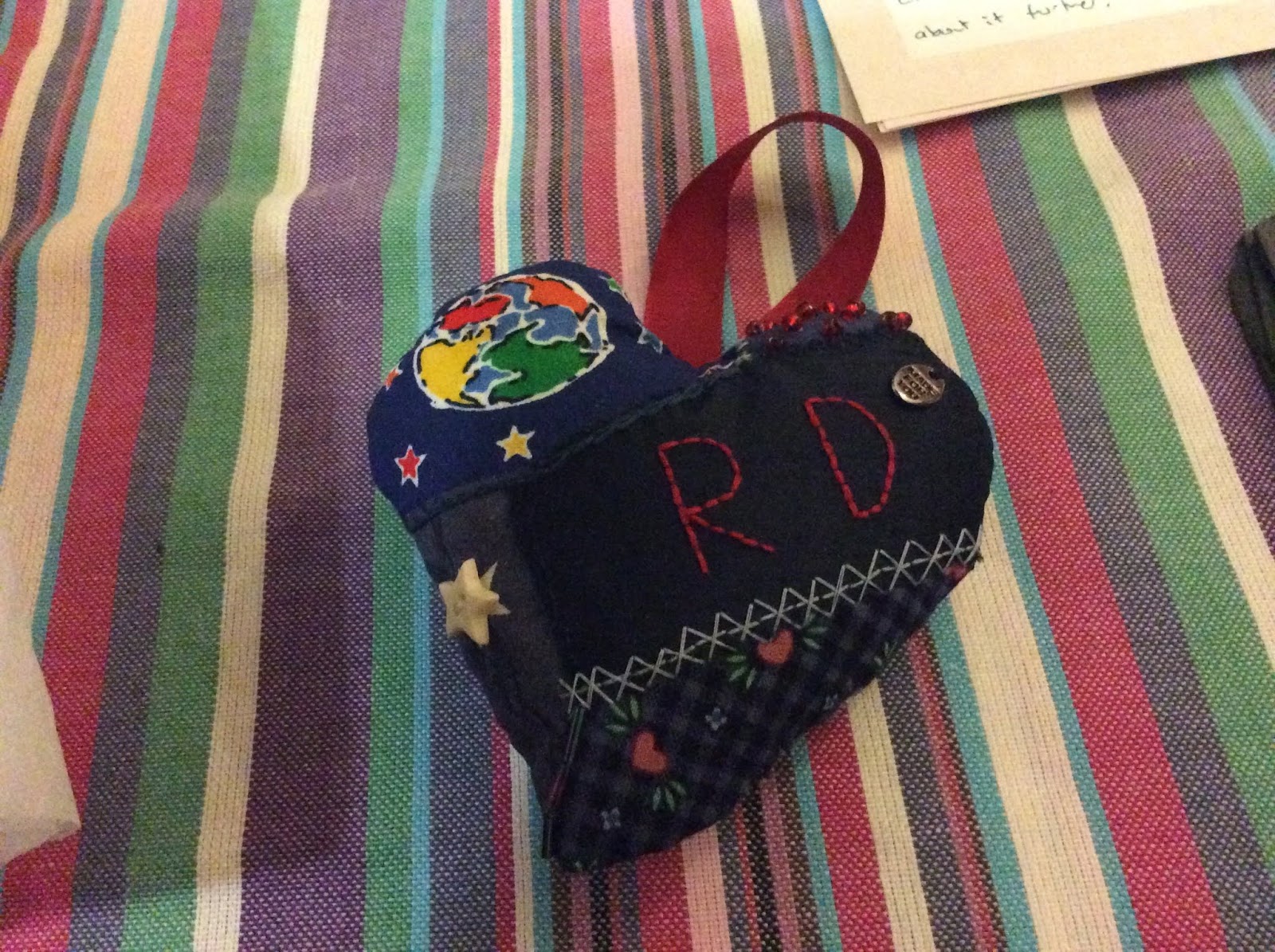
I could not believe it, and it spurred me on to attend the signing and be nice to the man. But I wanted to do more than that and felt called to show him a different side of Christianity, the faith that teaches me to love God, and love my neighbour as myself. Love is the most important command, and overrides everything else. I have recently discovered the Craftivist movement, which seeks to spend time and effort protesting positively, quietly and kindly through handmade items. I set about creating a gift for Richard that celebrated our commonality. Nothing inflammatory or that challenged his world view, apart from maybe what Christians were like. It was a challenge to find him after the Q&A session, but I managed it, and was able to shake his hand and pass over my letter and gift.


I was amazed to receive a personal email from him later in the evening, thanking me for the gift. 

This week I have challenged all the D pupils to investigate a view that is the opposite to one they hold, to do some research and look into their similarities and differences. Difference should be celebrated, not feared.

As a result, I’m really looking forward to Bryanston’s Craftivist Group, an extra-curricular activity (ECA) which I will be hosting from January. Craftivists aim to change the world through well-thought-out, quiet and kind acts of loving protest.

4 October 2019

A uniquely human and humanising activity: a reflection on why music education matters

After an insightful Music Education Conference at Bryanston yesterday, the Director of Music, Stephen Williams, reflects on why music education matters...

Even during the high-octane political turmoil of recent weeks, news about the decline of music education made it onto the BBC News at Ten. The BBC’s theme – that the serious underfunding of music provision will have an impact for generations – is supported by an increasing amount of evidence. No one is immune; the effects are being felt in independent and free schools, in academies, in the maintained sector and in the county music hubs. Two of our leading institutions, the Royal College of Music and the Royal Academy of Music, have issued a joint statement: This is a matter of significant importance not only for the higher music education sector but also for the pipeline of musicians of all types for this country and beyond.

The UK’s recorded music industry has contributed over £5 billion, in music exports, to the UK economy since 2000. We have some of the finest orchestras, soloists and choirs in the world; we are an undoubted international leader in all forms of music-making.

Music has a positive impact on the well-being and mental health of the nation and stimulates the developing brain in the way that no other activity can. Not just that, it represents a refuge for those who live with dementia and Alzheimer’s; singing and playing should clearly be prescribed.

We have just hosted a national Music Education Conference. Delegates came from around the UK to hear specialists talk about the ways that we can stem that decline. Jimmy Rotherham is the remarkable music teacher at Feversham Primary School. Set in an impoverished area of Bradford, and after many years in special measures, the school took the bold decision to saturate the day with music; singing in assembly, sums to a tune, a staff choir, literacy through singing, percussion work for co-ordination and composure. The results were remarkable and led the school to achieve ‘outstanding’ status. Behaviour, attainment and attendance were all transformed.

Three of the speakers talked about that popular myth of being either intrinsically (genetically?) ‘musical’ or ‘unmusical’. It is in fact the case that every one of us absolutely can make music. Indeed, research into the origins of our species shows that our larynxes were designed initially for song rather than speech. We, musicians, need to hold up our hands and recognise that we have a crucial role in discouraging the negative feedback that leads young children to believe that they are either unmusical or unable to sing.

We believe that ours is a uniquely human and humanising activity. With that in mind, the whole D year group (Year 9) are learning songs from Les Misérables to sing in the London Concert on 25 October. Their focus and singing have been remarkable and their conversations about the themes of those songs – love, loss, alienation, rejection, injustice and compassion – have been powerful. Words and music are such a potent mix; meaning and emotion coalesced. At this week’s Musicians’ Showcase we witnessed Honey H creating a uniquely compelling silence as she communicated the text of her song. Every week we are fortunate, as music teachers, to witness these special moments.

Simon Toyne spoke at the conference about his work as Executive Director of Music in 34 academy schools. Echoing earlier speakers, he talked about the impact on behaviour and achievement across all of those schools and the civilising influence of music even on the pupils who hear it as they walk past morning rehearsals.

A 25% drop in the number of pupils taking GCSE Music nationally over the past ten years and a consequent reduction of A level numbers by 40% is sobering and that is mirrored in a reduction in those who take part in music ensembles. At the same time our understanding of the deep, positive and lasting neurological impact of music on our sons and daughters increases every day. Every teenager in the UK undertakes several subjects and activities that they wouldn’t otherwise choose to study. As the research into the developmental importance of music gathers pace, perhaps we will soon make it our universal practice to include ensemble singing and playing in that compulsory portfolio of subjects.

19 July 2019

Life is the adventure

A few weeks ago I spoke at my last Speech Day as a Head of Bryanston School. A leitmotif of my final chance to hold forth to a full Greek Theatre was of not outstaying one’s welcome and knowing when it is the right time to stay or to go. I used one of my favourite poems, which I quoted on my first Speech Day at Bryanston 14 years ago, as part of the text. 


Ithaka
As you set out for Ithaka
hope your road is a long one,
full of adventure, full of discovery.
Laistrygonians, Cyclops,
angry Poseidon—don’t be afraid of them:
you’ll never find things like that on your way
as long as you keep your thoughts raised high,
as long as a rare excitement
stirs your spirit and your body.
Laistrygonians, Cyclops,
wild Poseidon—you won’t encounter them
unless you bring them along inside your soul,
unless your soul sets them up in front of you.

Hope your road is a long one.
May there be many summer mornings when,
with what pleasure, what joy,
you enter harbors you’re seeing for the first time;
may you stop at Phoenician trading stations
to buy fine things,
mother of pearl and coral, amber and ebony,
sensual perfume of every kind—
as many sensual perfumes as you can;
and may you visit many Egyptian cities
to learn and go on learning from their scholars.

Keep Ithaka always in your mind.
Arriving there is what you’re destined for.
But don’t hurry the journey at all.
Better if it lasts for years,
so you’re old by the time you reach the island,
wealthy with all you’ve gained on the way,
not expecting Ithaka to make you rich.

Ithaka gave you the marvelous journey.
Without her you wouldn't have set out.
She has nothing left to give you now.

And if you find her poor, Ithaka won’t have fooled you.
Wise as you will have become, so full of experience,
you’ll have understood by then what these Ithakas mean.

C. P. Cavafy
(Translated by Edmund Keeley)

For me this is the most remarkable poem, and for many reasons. It talks of life as something one shouldhope will be an adventure, a road full of discovery. It talks about the monsters you will find onyour way: the Laestrygonians, Cyclopes, and even an angry Poseidon. It talks too of summer mornings and the many harbours you will find where you can buy fine things. Of visiting Egyptian cities to learn (and go on learning) from their scholars. It talks of perhaps,and if so, only finally, finding Ithaka, your homeland to which you will return, and of not being disappointed if she seems now poor after your life well-travelled. Because the point of life is the travel: the point of life is the adventure.

I don’t think I quite knew what I was taking on 14 years ago; I find that Cavafy means just as much or more to me now, as I push off from this harbour and move on to the next. I shall not pretend that I have not met my fair share of Laestrygonians and even the odd Cyclops in my time here. I like Cavafy’s point that we tend to bring these monsters with us; it’s how we respond to the travelling, the adventure, those monsters, and the joyful engagements that life is all about. 


But, oh how the wonderful moments far outshine these monsters. And these wonderful moments are mainly, but not completely, formed around our pupils. That’s why people join the teaching profession: being involved with growing minds and their nurture is the greatest privilege. 

Kairos esti. More Greek, this time ancient. It’s the right time. That sense that, although one’s job may never be fully completed and although there’s always more you can do, that you still love a place and its people, that the mission is as clear as ever, it is, nevertheless, time to move on. It is for me and it is too for our departing A2s. Most of them joined us five years ago and, boy, they’ve grown along the way. Zeynep, our wonderful Head Girl, dancing her socks off here, learning how to stretch right outside her comfort zone, and off to study History of Art and to continue to excel. Some of that is predictable, but I might have expected her to settle for merely being an international skier: not Zeynep. Then Cameron, our Head Boy, who joined us just two years ago in the sixth form, who is my first Head Boy who joined in A3. Cameron’s drive, energy and passion to get things done and done right is a lesson to us all. Together he and Zeynep have led a superb group of prefects and I could not be more proud of all of them. Or of Kate and Amadea off to top music schools in London. Or Sumei off to Durham perhaps, for Modern Languages, to be followed by a Masters in Music, I hope: with a voice like Sumei’s, surely she must! Or Freddie winning not one but two organ scholarships to two prestigious universities and a further one to St Paul’s Within the Walls, Rome and still loving a good suit and a proper cup of tea. Or Luca and his outstanding music and contributions to it all. Or Clara and her remarkable drama. (Will I ever get over her portrayal of me?) Or Callum and his ability to lead, drive, and succeed. Or Molly; wherever she chooses to go to university she’ll be brilliant, and then on, no doubt, to run a small country somewhere. Or Frankie off to Loughborough via Singapore.   Do they represent the hope of our prospectus? To produce well-rounded 18-year-olds ready to go out and contribute to the world. Yes, they do. Is that what we all hope for our children? Lord, I hope so. I want all the A2s to be able to move on and do something. To keep doing and be happy. To be involved and engaged. To know their real worth and what they can bring to the enterprise, whether that’s a ski season in Japan or linguistics at Oxford, I don’t mind. But I do think they should be equipped to deal with this world and to do so in a way which will bring them joy, as Cavafy promises us, on their own road to Ithaka.


As our departing A2s leave to travel along that road, I commend to them first these famous words of Tennessee Williams:

The world can be violent and mercurial and always has been. It will have its way with you. We are saved only by LOVE. Love of each other. Love that we pour into the art that we feel compelled to share. By being a parent, being a writer, being a painter, being a friend.

And finally in my own last words to all A2s: Go out and spread the Bryanston message. The world needs it. Be wonderful. Be an aardvark, a flamingo or a tiger. But, whatever you do, be yourself. And don’t be a sheep. BAAA!


We would like to thank Sarah Thomas for her outstanding leadership of Bryanston throughout her 14 years as Head. We wish Sarah and her family all the best as they set out on the next part of their journey to Ithaka. The next edition of the OB Magazine will include a full valete to Sarah.



21 June 2019

Moving on

There is change in the air here at Bryanston. At the end of term, a cohort of our pupils and some long-serving members of staff will be leaving for pastures new. Many of the pupils will have spent two, three, four or five years at this most amazing of places to live and work.

In many ways change can be unsettling. We ask ourselves ‘What is it going to be like?’ or ‘Will it be the same?’ At times of change we might look to the future with a sense of uncertainty or anxiety.

But there is no need to worry. Schools are experts at change. Every year at least one fifth of our cohort leave and another vast number, thanks to our amazing Registrar, Anne Megdiche, prepare to join us. Our academic curriculum at Bryanston is constantly changing; it is dynamic, and it is adapted and improved on each year. More often than not, exam boards themselves make significant changes to their syllabus. Our co-curriculum is similarly adaptable, with new opportunities being presented as requested, desired and/or according to staff expertise and interests. It is in the DNA of schools that they must and should adapt and change. Any organisation not willing to change is not fit for purpose.

Of course, there are things that do not change: things that will still be familiar to those leaving now as when they come back on their 10th, 20th or even 70th anniversary reunions. The main school building and the vastness of our grounds will remain the same. At a recent OB event, the significant building programme that has been undertaken over the past decade was noted but there was also a recognition that the positive ethos of the School remains unchanged.

The idea of change is embedded in our school motto: et nova et vetera. It reminds each of us that we should retain all the good about the old, and embrace the future with welcome arms.

Having et nova et vetera at the heart of our school community ensures that we prepare our most valuable asset, our young people, to be able to embrace change and be resilient when faced with it. This will equip them for life beyond these school grounds.

For me, the example of Jesus Christ is the ultimate role model when it comes to embracing change. He constantly challenged those around him to examine and re-evaluate the reasons behind the values and traditions of his time. As I write, the Church has just celebrated Whitsun, or Pentecost, when the Holy Spirit descended on Jesus’ disciples. From that moment they stopped becoming disciples or followers, and became apostles, teachers of the Good News of Jesus and the love of God. They helped change, transform and enrich (for the most part) the lives of countless people. Without embracing the Holy Spirit, the message of Jesus would probably not have spread so far and so quickly.

Whatever you may or may not believe spiritually, I am sure you appreciate the importance of being willing and able to face change, adapt and, where possible, make the most of any new opportunities that may arise.

After 11 very happy years at Bryanston, it is time for the Haviland family to embrace a significant change. We have been asked a number of times if any of us are anxious or nervous about leaving: it would be foolish to say we weren’t. However, we are also looking forward to a new challenge in a different context. To be Chaplain to a community like Bryanston has been very special. To be able to be alongside people at significant times in their lives is a huge privilege that I have never taken for granted. Building relationships has been key and moving on from these will be a massive wrench: I have got to know well many amazing people. In the school church, in these last 11 years, over 500 members of our community have been confirmed, 105 have been baptised, about 50 couples have been married or had their marriage blessed, and there have been a number of significant funerals or memorial services. For each one of these, I have had the chance to get to know each person or family really well. As important has been the valuable time spent being around for others in our community – to smile, chat and encourage where I can. Thank you for allowing me to be a part of your lives.

Life as Chaplain is thoroughly enjoyable, but also demanding. I could not have carried out the role without the support and encouragement of the Bryanston community, led by Sarah Thomas. This has allowed me the professional time and space to carry out my duties. Just as important has been the love and care I have received from my wife, Jo, and my three boys, George, James and Charlie. Thank you.

Like all in our community who are leaving at the end of this term, the Havilands leave with many happy memories acquired here at Bryanston. These will stay with us in our new life beyond the school gates and we will cherish them. The vibrant Bryanston alumni community, which all leavers are invited to join, will allow us to continue to be connected with the wider Bryanston family.

So, let us embrace the change that is coming with hope, wherever it will take us. Rest assured that Bryanston is in good hands. The Revd Jo Davis will be taking the baton from me as Chaplain in September. I commend her to you. With those who are staying and those who are arriving, the School will continue to go from strength to strength. And may God continue to bless this community with His love, joy and peace.

Et nova et vetera!

Andrew
The Reverend Canon Andrew M J Haviland
The Chaplain, Bryanston School
June 2019

5 June 2019

Learning happens when we listen: what’s the point of the Bryanston Education Summit?


”We need to create environments in which teachers embrace the idea of continuous improvement… an acceptance that the impact of education on the lives of young people creates a moral imperative for even the best teachers to continue to improve.” (September 2014) – Dylan Wiliam

As education establishments, it is our responsibility to help facilitate continual professional improvement. Events like the Bryanston Education Summit are excellent for bringing together a number of different professional development strands under one roof. Attendees can curate their own, bespoke programme for the day and hear from a wide array of expert speakers on a number of topics. The event is intended for many teachers from many schools and we cannot know what those particular schools or teachers are specifically interested in improving. Therefore, we lay on a variety of topics in the hope that there really is something for everyone.

That is not to say that an event like the Education Summit is not good for Bryanston. It creates tremendously good-value professional development for our own staff. They attend sessions where their teaching commitments allow and so digest many talks during the day. The knock-on effect is that it provides a frame of reference for our staff: they can discuss what they have heard and learned with others from the same context, which in itself adds a layer of benefit. To some extent, any school that is able to send more than one teacher to the event could benefit in a similar way.

Sustained CPD, as research has concluded, is one of the only truly effective ways to make professional improvement lasting and genuinely impactful in the classroom. At each Summit, we align at least a few talks and speakers with our own pedagogical focus for the year. That way, we can lay on a number of preludial pedagogical events in the months leading up to the Summit, send teachers to hear relevant talks at the Summit itself and then host follow-up meetings to truly embed some of the concepts discussed. This year, for instance, our pedagogical focus as a school is literacy. It is no surprise, therefore, that there are a good number of talks and speakers at the 2019 Summit specialising in that very topic. Among them, Alex Quigley will be giving a talk entitled ‘Where does literacy fit in the secondary school curriculum?’; Debra Myhill will be speaking about ‘Writing in subject disciplines’; and Marcello Giovanelli will be discussing the importance of ‘Knowing about language: what, why and how?’ By directing our own staff to these particular talks, I can guarantee that literacy will continue to gather momentum within our specific learning community.

Under the umbrella of our overall summit focus, ‘Revolution: the future of learning in a changing world’, we strive to provide an array of subjects. It is also important to us not to shy away from some of the more challenging issues facing us as educationalists. This year we have Robert Plomin summarising his 45 years of research on how ‘DNA makes us who we are’. This will not be entirely comfortable listening for some teachers. Anthony Seldon will be speaking about Artificial Intelligence and how it will change your world – whether you like it or not, again, possibly not making for the easiest of listening. We intend to begin debate, but not necessarily settle it. First and foremost, we aim to get teachers thinking and reflecting.

In Dylan Wiliam’s talk at our inaugural Education Summit in 2017, his final presentation slide was the following:


His first bullet points for both teachers and leaders concern the need for high expectations of continual professional improvement. Our Education Summit provides a focal point for such a requirement, both for ourselves and others. Learning happens when we listen, and our Summit has, at its heart, a desire to connect teachers, to spark debate, and to promote the idea that the best teachers – irrespective of age or experience – are always ready to listen, learn, and share their experiences. 


16 May 2019

“All change please, all change” – well, not quite: the transition from a junior to a senior boys’ house


Growing up in London and venturing onto the London underground system, I was always anxious about the need to change lines to get to my required destination. Was I aiming to head north or south, east or west, and what was I to do when the tannoy announced “all change please, all change”?

From the outside, moving up to a senior boys’ boarding house at Bryanston might seem a little like this. While a sense of anticipation, even some concern, is perfectly understandable, it is important to remember that it is not “all change” by any means. The grounding of a year in a junior house is already in the bag, so pupils know where to go when asked to meet in Main Hall, or realise that having an assignment in Dorchester is basically working on prep in the maths subject room rather than working on some undercover operation in Dorset’s county town.

Similarly, as Year 9 boys transform into Year 10s when they arrive in their second September at Bryanston, they have the immense comfort of returning to the guidance of their existing tutor. While the new academic year represents a clean slate, a tutor will knowingly ask about the summer break in Cornwall perhaps, or a particular theme from the previous term’s reports, and then of course, how their charge is settling into their new senior boarding house. The continuity provided by the Bryanston tutor system is one of the key elements that eases what might otherwise be a more fundamental transition.

The move has also been smoothed by the hard work undertaken in the summer of Year 9. The process starts with a senior housemaster receiving a confidential list in their common room pigeon hole; it is like Christmas, except we have no real idea at that point who is coming our way. There follows a rapid round of enquiries about this list of names, where we know there is no randomness or partiality at all – the list has been carefully crafted to meld together a group who will live under the same roof for the next four years of their school life. The boys themselves have suggested who they’d like to be with, the junior housemasters have balanced this against the need to share talent around the five senior boys’ houses and an honest assessment of what is best for each boy, and the alchemy is completed by a dash of careful social engineering. The senior housemasters then receive a ‘dossier’ on each new boy coming their way. All in all, it equates to the planning we might all make before embarking on a tube journey across a capital city.

I (and the other senior housemasters) then meet our new boys, inviting them to visit their new boarding house for a quick look around; in the following weeks there is also an overnight camp by the river, team-building, story-telling, a group BBQ perhaps, and a ‘graduation day’ when I also get to meet the new parents. Finally, before the summer holiday begins, the dorm combinations for September are arranged, i.e. the boys know who they’ll be in a room with in the first term of the next academic year, avoiding the peril of a tenterhooks return to school in September.

Once in the senior house, like all tube journeys, there is not one route that fits all, so the journey to the Leavers’ Ball at the end of Year 13 can take various detours with stops along the way, and the route each pupil decides to take is pretty unique to them. Some will take the Circle Line all the way from South Kensington to King’s Cross, while others will opt for the Piccadilly, Central or Victoria line, and that’s because a pupil will have different skills or preferences. It matters not because they all reach their final destination in the end and with their personal confidence pretty well complete. Some might take the circuitous route for a while, or pass through many more stops along the way. Some may even go south on the Bakerloo when they should go north; but between the housemaster, tutors and teachers, we will nudge them in order to get them going back in the right direction towards Baker Street.

During four years of travel, there is plenty of guidance offered so that any pupil should know what’s coming up and when they need to react. “The next station is Paddington. Change here for the Bakerloo line and National Rail services”. And then there is my own personal favourite – ‘Mind the gap’. Nobody aims to put a foot wrong, but it does occasionally happen, even if the warnings have been made clear. Unlike the junior houses, the adolescence card is in play rather more, and this is part of growing up – but we are on hand to avoid the ‘gaps’ or to pull the emergency handle as required.

Finally, unlike at some schools, the senior house does not alone define an individual at Bryanston, rather it is what they achieve in the milieu of the whole school which does. Yes, the friends and experiences they have in their house are deeply personal and unique to the surroundings, but, like each and every tube carriage, they will spend so much time with other people, each with their own individual personalities, that it is the journey through school as a whole which has the greatest resonance.

So, for those of you reading this who are curious or even a little uncertain about Bryanston’s transition of house for boys between Years 9 and 10, it is far less a matter of ‘all change’ than might seem. More like a little change, at the right time, at the right station, and onto the right line with plenty of comforting continuity.