Showing posts with label humanity. Show all posts

2 December 2019

Celebrating difference

God made us all, each wonderfully different...


(Church of England, Common Worship service of Holy Communion)


School Chaplain Reverend Jo Davis reflects on the importance of seeking to understand the differences and similarities in everyone we meet whilst, above all, treating them with kindness as a fellow human being...

Since I arrived at Bryanston 10 weeks ago, I have been told many times that there is no Bryanston type. That our aim is not to fit everyone into a mould, but to support them to become a fuller, brighter version of themselves.

I believe that everyone in the world has an equal right to exist and have their own beliefs and opinions. As a Chaplain, it is my job to support and pastorally care for everyone in the school, religious or not. If their faith differs from mine, it’s my responsibility to ensure that they are supported in their faith.


You rejoice in our differences, yet we make them a cause of enmity.


As an RS teacher, I have taught all six of the major faiths including atheism. I consider it a privilege to do so, but I also think it is hugely important. Just because I disagree with someone, it doesn’t mean that I do not need to understand their point of view. Learning about Islam to teach it to GCSE level has given me many opportunities to reflect on my own faith. If we don’t understand the opposing view to our own, how do we know that we don’t agree with it? We should seek to understand the differences and similarities in everyone we meet whilst, above all, treating them with kindness as a fellow human being.

This culminated on Wednesday last week in my attending a book signing with Richard Dawkins in Bath, accompanied by a group of A2 pupils. A man who, it could be said, has views diametrically opposed to mine, but I was still looking forward to it. 

When doing some research beforehand I was staggered to come across a video entitled ‘Love Letters to Richard Dawkins’ where he reads out some of the horrifically offensive emails he receives, many from people claiming to be Christian, but wishing him a horrible death and eternal suffering in hell. 

I could not believe it, and it spurred me on to attend the signing and be nice to the man. But I wanted to do more than that and felt called to show him a different side of Christianity, the faith that teaches me to love God, and love my neighbour as myself. Love is the most important command, and overrides everything else. I have recently discovered the Craftivist movement, which seeks to spend time and effort protesting positively, quietly and kindly through handmade items. I set about creating a gift for Richard that celebrated our commonality. Nothing inflammatory or that challenged his world view, apart from maybe what Christians were like. It was a challenge to find him after the Q&A session, but I managed it, and was able to shake his hand and pass over my letter and gift.


I was amazed to receive a personal email from him later in the evening, thanking me for the gift. 
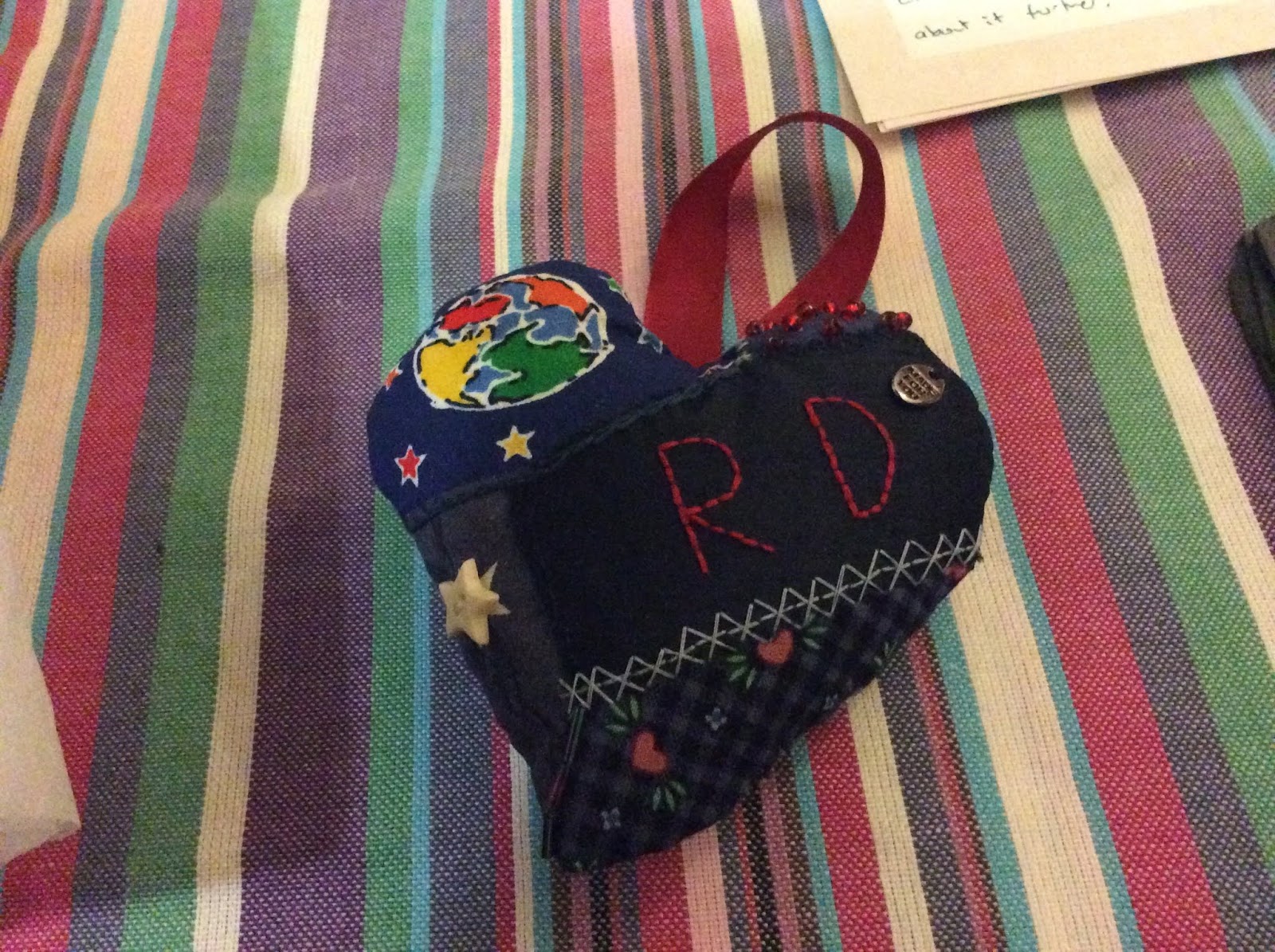
This week I have challenged all the D pupils to investigate a view that is the opposite to one they hold, to do some research and look into their similarities and differences. Difference should be celebrated, not feared.

As a result, I’m really looking forward to Bryanston’s Craftivist Group, an extra-curricular activity (ECA) which I will be hosting from January. Craftivists aim to change the world through well-thought-out, quiet and kind acts of loving protest.

4 October 2019

A uniquely human and humanising activity: a reflection on why music education matters

After an insightful Music Education Conference at Bryanston yesterday, the Director of Music, Stephen Williams, reflects on why music education matters...

Even during the high-octane political turmoil of recent weeks, news about the decline of music education made it onto the BBC News at Ten. The BBC’s theme – that the serious underfunding of music provision will have an impact for generations – is supported by an increasing amount of evidence. No one is immune; the effects are being felt in independent and free schools, in academies, in the maintained sector and in the county music hubs. Two of our leading institutions, the Royal College of Music and the Royal Academy of Music, have issued a joint statement: This is a matter of significant importance not only for the higher music education sector but also for the pipeline of musicians of all types for this country and beyond.

The UK’s recorded music industry has contributed over £5 billion, in music exports, to the UK economy since 2000. We have some of the finest orchestras, soloists and choirs in the world; we are an undoubted international leader in all forms of music-making.

Music has a positive impact on the well-being and mental health of the nation and stimulates the developing brain in the way that no other activity can. Not just that, it represents a refuge for those who live with dementia and Alzheimer’s; singing and playing should clearly be prescribed.

We have just hosted a national Music Education Conference. Delegates came from around the UK to hear specialists talk about the ways that we can stem that decline. Jimmy Rotherham is the remarkable music teacher at Feversham Primary School. Set in an impoverished area of Bradford, and after many years in special measures, the school took the bold decision to saturate the day with music; singing in assembly, sums to a tune, a staff choir, literacy through singing, percussion work for co-ordination and composure. The results were remarkable and led the school to achieve ‘outstanding’ status. Behaviour, attainment and attendance were all transformed.

Three of the speakers talked about that popular myth of being either intrinsically (genetically?) ‘musical’ or ‘unmusical’. It is in fact the case that every one of us absolutely can make music. Indeed, research into the origins of our species shows that our larynxes were designed initially for song rather than speech. We, musicians, need to hold up our hands and recognise that we have a crucial role in discouraging the negative feedback that leads young children to believe that they are either unmusical or unable to sing.

We believe that ours is a uniquely human and humanising activity. With that in mind, the whole D year group (Year 9) are learning songs from Les Misérables to sing in the London Concert on 25 October. Their focus and singing have been remarkable and their conversations about the themes of those songs – love, loss, alienation, rejection, injustice and compassion – have been powerful. Words and music are such a potent mix; meaning and emotion coalesced. At this week’s Musicians’ Showcase we witnessed Honey H creating a uniquely compelling silence as she communicated the text of her song. Every week we are fortunate, as music teachers, to witness these special moments.

Simon Toyne spoke at the conference about his work as Executive Director of Music in 34 academy schools. Echoing earlier speakers, he talked about the impact on behaviour and achievement across all of those schools and the civilising influence of music even on the pupils who hear it as they walk past morning rehearsals.

A 25% drop in the number of pupils taking GCSE Music nationally over the past ten years and a consequent reduction of A level numbers by 40% is sobering and that is mirrored in a reduction in those who take part in music ensembles. At the same time our understanding of the deep, positive and lasting neurological impact of music on our sons and daughters increases every day. Every teenager in the UK undertakes several subjects and activities that they wouldn’t otherwise choose to study. As the research into the developmental importance of music gathers pace, perhaps we will soon make it our universal practice to include ensemble singing and playing in that compulsory portfolio of subjects.

13 July 2018

Speech Day reflections


As another school year comes to an end, Sarah Thomas looks ahead to the future with one foot firmly rooted in the past. Discover why she believes that Bryanston’s motto of “Et Nova et Vetera” – both the new and the old – is more apt than ever.

Back in January, Bryanston turned 90 and through OB Simon Wheeler’s (C ’93) extraordinary series of films, we are able to look back and remind ourselves of why this school is so special. The place, the people, the ideas and the principles that continue to guide us. In June, we were able to look forward, with the announcement of my successor.  I’m delighted that Mark Mortimer will be leading Bryanston onwards and upwards from September 2019 and look forward to having a year in which I can do whatever makes most sense to allow him, his lovely wife Anna and their three children, to get to know this wonderful school. 

Image of Head, Sarah Thomas conducting her speech
Speeches in the Elder Concert Hall
At last year’s Speech Day, the Chairman spoke on the theme of necessary change and evolution within schools. Schools do change.  They must; they would disappear into oblivion if they did not.  But that does not mean that the things that matter must change.  Our guiding principles of creativity, breadth of ambition, individuality, the sense of a loving family, of humanity, and of resilience, have been embedded in our DNA since 1928 and will endure, I am certain, because of Bryanston’s collective good sense, the quality of the governors, and their choice of excellent headmasters. Those guiding principles will ensure that Bryanston continues to evolve boldly and positively, without losing the critical constituents of what makes Bryanston Bryanston.

Peter Tait, former headmaster of Sherborne Prep and a great friend of Bryanston, likes to torment us with this question: ‘What is a proper curriculum?’ Are we still, in effect, teaching what we taught 50 years ago, regardless of new, more relevant subjects, and without reference to what our pupils actually learn from them?  Teaching is not after all learning.  Then there are the real-world issues: funding for state schools and affordability for the independent sector; the fact that more overseas children are now educated in branches of UK independent schools abroad than here in the UK; and above all there’s the looming threat of AI. What kind of world are we actually preparing our young people for? And how do independent schools – how does Bryanston – stay relevant in the face of the fantastically significant changes that are coming our way? 
Image of Duncan Emerson conducting the orchestra
Duncan Emerson directs the orchestra


Sir Anthony Seldon in his book The Fourth Education Revolution challenges the model which most schools still adhere to – that of The Third Revolution: industrialised learning; schools as factories; chalk and talk, or its 21st-century equivalent, Powerpoint and talk. Sir Anthony predicts we will meet the challenges of AI by adopting a new model and following a 5-point plan: (i) ending early specialisation in schools; (ii) investing in staff who understand learning and analytics and technology; (iii) emphasising the human in education, to produce competent adults who are better than any algorithm; (iv) personalising learning; (v) challenging and stretching young people, by making school more than about lessons.

Image of pupils and parents relaxing on the grass
Guests relax in the sunshine
This is precisely the model that Bryanston has striven to follow, and with some success, over the past 90 years, often in defiance of the conventional wisdom that academic success is the be all and end all. Ending early specialisation? Embracing personalised learning? Stretching our pupils beyond the classroom? Look at our tutorial system and the Dalton Plan, our correction periods and one-to-one attention to the individual.  Added to that, we have a curriculum that is particularly diverse in the formative D year, an extraordinary range of extra-curricular opportunities and an A level programme which always seeks to ensure there are no impossible subject combinations. And better still, the IB.

Image of pupils playing tennis on the grass courts
Tennis on the grass courts
Bryanston’s model has explicitly set out to help children to develop the human.  It’s why Bryanstonians invariably end up in such a range of careers and don’t necessarily trot off into those professions which, we are told, will soon no longer exist. At Bryanston we have always known that education is not about mere subjects.  It’s about an outlook, an attitude, a lifelong ability to learn and adapt; to work in teams; to influence and persuade; to direct and lead. To laugh at yourself and to put things right when you’ve gone wrong. The future requires real people, with real values and real emotional intelligence. And real education.

Whilst the changes technology have brought have been huge (both for good and bad) I am happy to predict that one of the longer terms effects might be that we refocus upon, and rejoice in, what makes us human, not machine. Because the world changes – we all know that – but what does not change is what it takes to be human.